
Apply for your US visitor visa yourself.
You don't need a consultant for the B1/B2. You need to know what happens next, and how to answer a three-minute interview honestly and clearly. Read the free overview below, then decide whether the full step-by-step guide is worth it to you.
Independent guide by Visaroo. Not affiliated with the US Government. No guarantee of approval — nobody can give one.
Applying from Pakistan instead? See the Pakistan edition
Free overview
The B1/B2 visa in five minutes
What it is
The B1/B2 is the US visitor visa. B-1 covers short business visits such as meetings and conferences. B-2 covers tourism, visiting family and friends, and medical treatment. Most people are issued the two combined. It does not allow you to work for a US employer or study for credit, and it is a temporary visa: it lets you travel to a US border and ask to be admitted for a limited stay.
The one idea behind every refusal
US law starts from the assumption that every visitor-visa applicant might want to stay. In plain English, the officer begins the interview presuming you could be an intending immigrant, and your job is to show, truthfully, that you will return. Most refusals are issued under Section 214(b) for exactly this reason: the officer wasn't convinced.
That is why you're asked about your job, your family, your savings and your past travel. These are your ties: the work, relationships and commitments that make going home the obvious choice. Ties are not just documents. They are the picture your answers paint, and they only work if they're real.
The line you must never cross: never give false information or submit documents that aren't genuine. Willful misrepresentation can lead to a permanent bar. If something is true but awkward, explain it calmly instead of hiding it.
The 8 steps, in plain English
- 1
Get ready
Check your passport, gather proof of your UK status if you're not British, and decide the basics of your trip before you touch any form.
- 2
Complete the DS-160
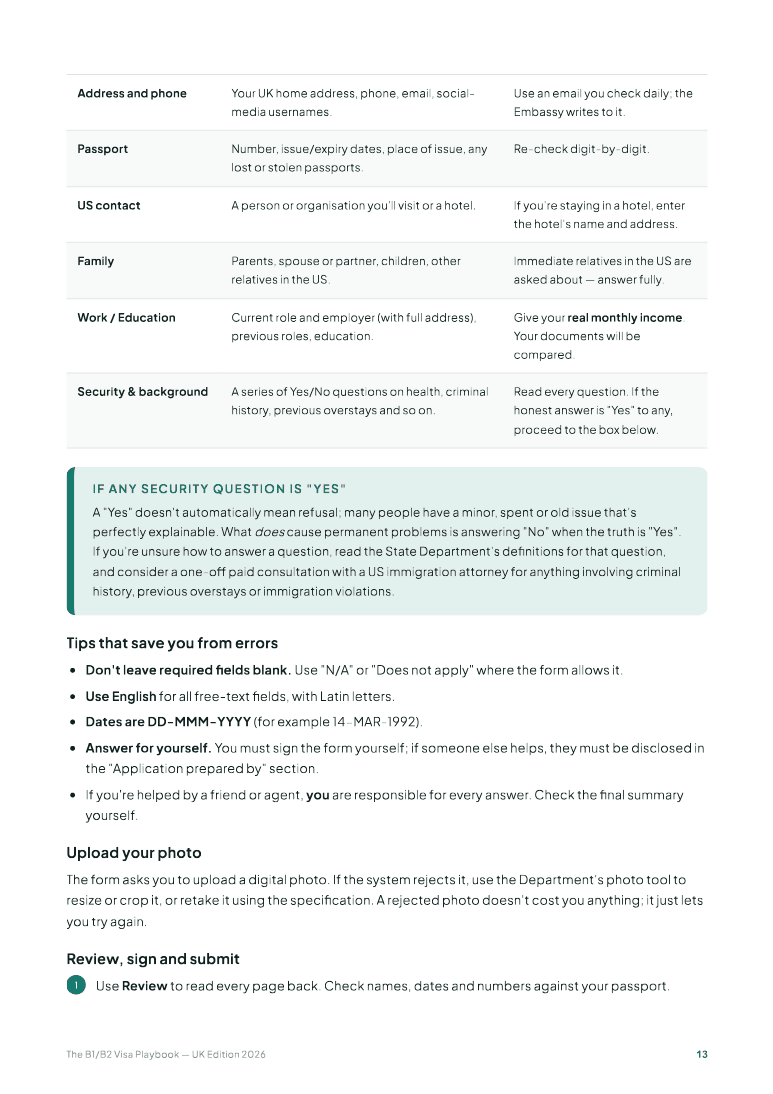
The free online application. It's the document the officer has read before you reach the window, so every answer must match your passport and your documents.
- 3
Pay the visa fee
US$185 through the official UK appointment site. It is non-refundable and non-transferable, so be sure of the visa type and the country first.
- 4
Book your interview
Schedule on the same official site and register for passport courier. Check wait times, and don't count on an interview waiver.
- 5
Prepare your documents
A short, organised folder that backs up your answers: job, money, home and trip. More paper is not better.
- 6
Interview day
Security, document check, fingerprints, then a short conversation at a window. Most of your time is spent waiting.
- 7
After the interview
Approved, 221(g) administrative processing, or a 214(b) refusal. Each one means something different and needs a different response.
- 8
Receive your visa and travel
Check the visa foil, then remember it only gives you permission to ask for entry. The officer at the border decides how long you stay.
That's the shape of it. The full guide gives you every screen, field, document and fee for each step. Check current fees and wait times on the official US Embassy and State Department pages before you pay.
Five mistakes that cost people money
Booking flights first. A refusal or a long wait for processing can leave you with a non-refundable ticket. Book flexible travel until the visa is in your passport.
Paying a middleman for the DS-160. The form is free at ceac.state.gov. Sites that charge to "submit" it are agents, and you remain responsible for every answer.
A story that doesn't match the form. Different salary, payer or dates in the interview than on the DS-160 is one of the quickest ways to lose the officer's trust.
Memorising a script. Officers hear the same rehearsed lines daily. Know your facts and answer in plain words instead.
Hiding a past refusal. A previous refusal can be explained. Concealing it is treated as misrepresentation, which can be far worse than the refusal itself.
Answer, anchor, stop
Use one method on every question. Answer the question in the first sentence. Anchor it with one fact that makes it real or ties you home. Then stop and let the officer ask the next question. Nervous applicants talk too much, and every extra sentence is another chance to contradict the form.
Why do you want to go to the United States?
Weak answer
"I want to see America and maybe look at some opportunities."
Strong answer (adapt to your facts)
"I'm visiting my cousin in Houston for her wedding on 14 June. I'm staying nine days and I'm back at work on the 24th."
Who is paying for your trip?
Weak answer
"My uncle will pay for everything" — when the form says you're paying yourself.
Strong answer (adapt to your facts)
"I'm paying from my savings. I've put aside about £4,000 over the past year."
Do you plan to move to the US one day?
Weak answer
"If I get the chance, I would."
Strong answer (adapt to your facts)
"No. My family, home and work are here. This is a short visit."
These examples show the pattern, not words to copy. Your answers have to be true and match your own documents.
You now know what to do.
Most people stall on the next part: how. Which field, which document, what to say when the officer asks something unexpected, and what to do if it goes wrong. That's what the full guide is for.
Inside the guide
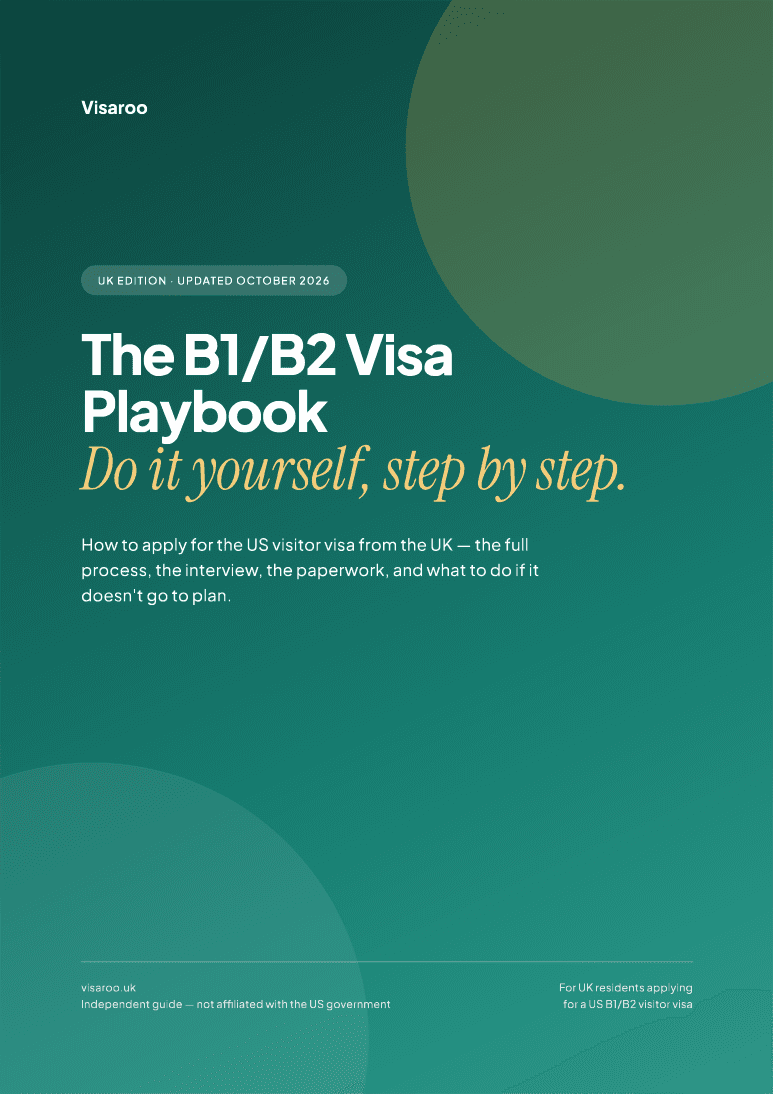
58 pages you can follow on your own
Written for UK residents applying in 2026, checked against official US Department of State and US Embassy London information in October 2026.
The step-by-step process
Eight steps from the UK with the official websites, fees, timings and a checklist for each.
DS-160, section by section
What to enter, and where applicants most often slip up.
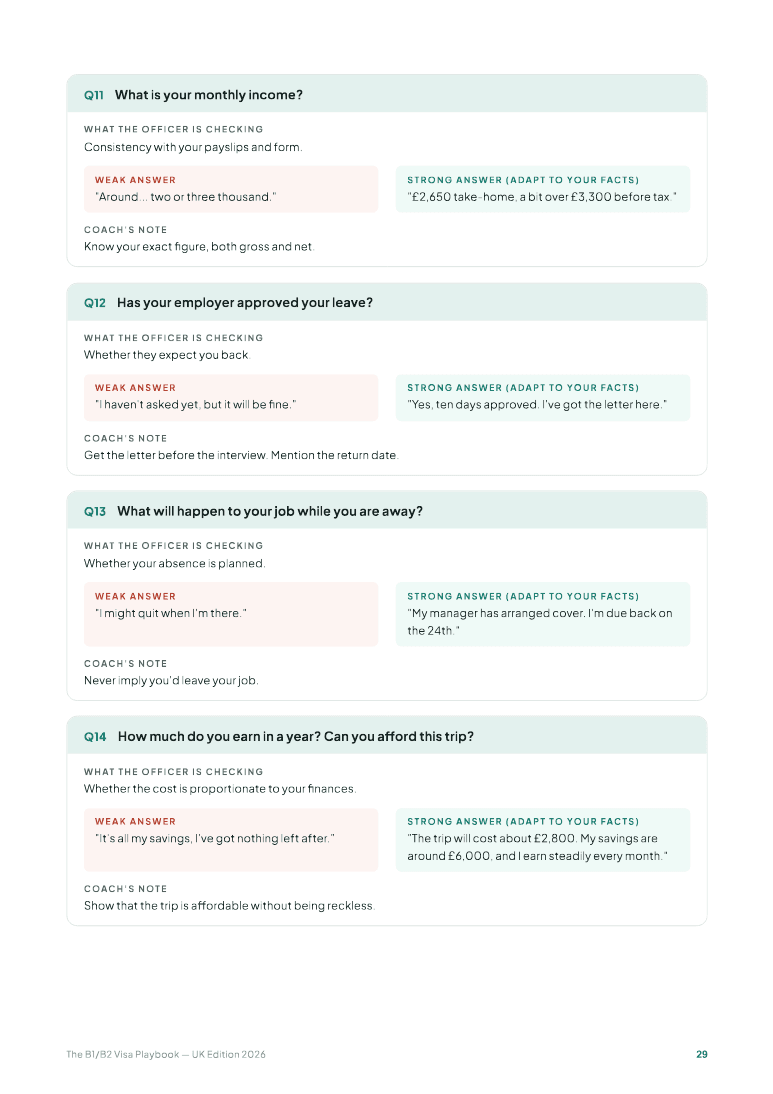
42 interview questions
What the officer is really checking, a weak answer, a strong one, and a coach's note.
Playbooks and a 7-day plan
Employed, self-employed, student, parent, retired, first-time traveller and previous refusal.
Worksheets and templates
Facts sheet, trip plan, folder index, employer and sponsor letters, mock-interview score sheet.
If you're refused
214(b), 221(g) and other outcomes explained, and an honest plan for whether and when to reapply.
Do it yourself, with a map.
A 58-page PDF that takes you from your first form to your interview and beyond, for a fraction of what a consultant charges to do the same.
- Instant PDF download, yours to keep and print
- The full 8-step process, with the official links
- 42 interview questions, 7 applicant playbooks and a 7-day practice plan
- Worksheets, employer and sponsor letter templates
- A recovery plan if you're refused
Educational guide, not legal advice. Not affiliated with the US Government. We can't guarantee a visa, and neither can anyone else. Fees and rules change, so the guide tells you where to confirm them before you pay.
It's for you if
- You live in the UK and want to apply for a US visitor visa yourself
- You have a genuine trip and a straightforward profile
- You want to save the consultant fee and are happy to follow clear steps
- You're nervous about the interview and want to practise properly
Get an adviser instead if
- You have a criminal record, a past overstay or a removal
- You were refused for misrepresentation or on grounds other than 214(b)
- A relative has filed an immigrant petition for you
- Your case has been in administrative processing for many months
Those cases need a US immigration attorney. The guide explains what to look for.
Questions, answered.
Can I really apply for a US visitor visa without a consultant?+
Yes. The DS-160, the fee payment and the appointment booking are all designed for individual applicants, and the DS-160 itself is free. The hard part is the interview, and that is what most of this guide is for.
Does the guide guarantee my visa will be approved?+
No, and nobody can. The decision is made by a US consular officer. The guide helps you prepare an accurate, consistent application and answer clearly and honestly. Anyone who guarantees approval is not being straight with you.
Is this guide only for people living in the UK?+
It is written for UK residents, including the UK appointment site, the London interview and UK status evidence. The DS-160, the interview method, the document advice and the refusal chapter apply to any B1/B2 applicant. If you're applying from Pakistan, there is a separate Pakistan edition with the Pakistani process.
How up to date is the guide?+
It was checked against official US Department of State and US Embassy London information in October 2026. Fees, wait times and waiver rules have changed recently, so the guide tells you exactly where to confirm the current position before you pay.
Is the US Government involved with this guide?+
No. Visaroo is an independent company. The guide is not legal advice and is not affiliated with or endorsed by the US Government, the Department of State or any embassy.
What if I have a criminal record, a past overstay or a misrepresentation finding?+
Those cases need advice from a US immigration attorney, not a self-help guide. The guide tells you when to get professional help and what to look for in an adviser.
Keep reading
US B1/B2 visa from the UK: the article
A shorter written overview of the process, with FAQs.
Read moreUK to USA visa page
Route facts, timings and our done-for-you service options.
Read moreVisa refused? How to reapply successfully
Our general guide to rebuilding a stronger application.
Read moreBank statement requirements guide
How to present your finances clearly and avoid red flags.
Read moreFree sponsor letter template
Build an editable sponsor or invitation letter in your browser.
Read moreFree visa readiness check
Six questions, then a personalised document checklist.
Read moreReady to do it yourself?
Prefer to hand it over? We also review applications and run full-service B1/B2 support for UK residents. See our pricing, take the free readiness check, or read the UK to USA visa page.